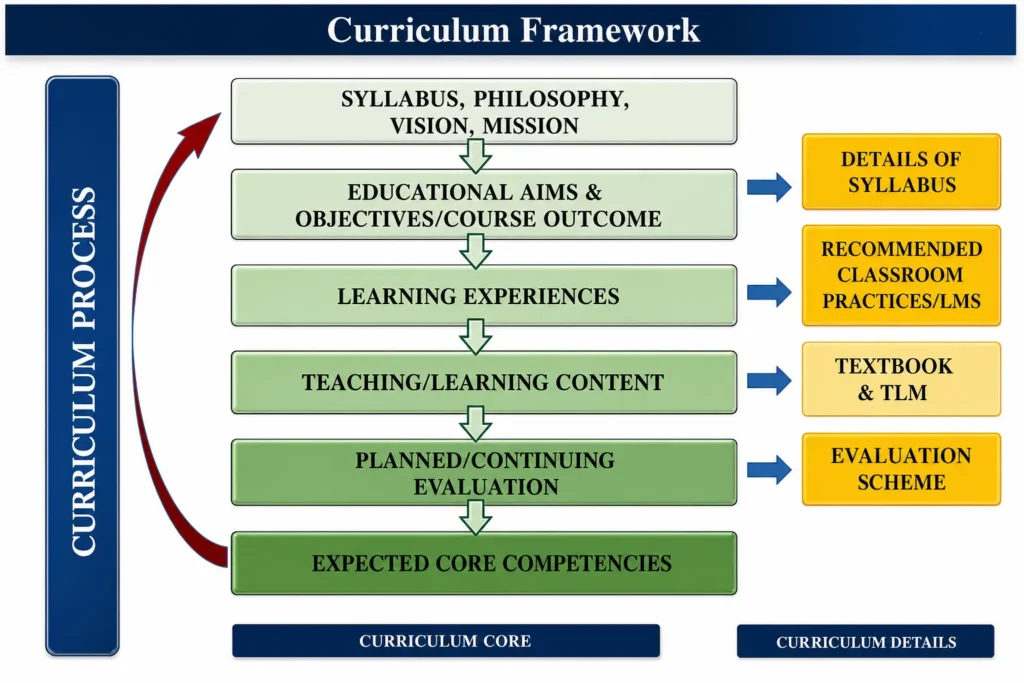
It is a plan that interprets educational aim vis-à-vis both individual and society to arrive at an understanding of the kinds of learning experiences college must provide to children.
The curriculum framework document provides direction to take up various educational activities, development of syllabus and textbooks. Etc.
LITTLE FLOWER COLLEGE OF NURSING, MANVILA, THIRUVANANTHAPURAM
Health is a state of well – being that enables a person to lead a physically, psychologically, socially and economically productive life. Health is a right of all the people. Individuals, families and communities have responsibility towards maintaining their health.
Nursing contributes to the health service in a vital and significant way in the health care delivery system. It recognizes national health goals and is committed to participate in the implementation of National Health Policies and Programme. It aims at identifying health needs of the people, planning and providing quality care in collaboration with other health professionals and community groups.
Scope of nursing practice encompasses provision of promotive, preventive, curative and rehabilitative aspects of care to people across their life span in wide variety of health care settings. Practice of nursing is based upon application of basic concepts and principles derived from the physical biological and behavioural sciences, medicine and nursing.
Nursing is based on values of caring, and aims to help individuals to attain independence in self-care. It necessitates developments of compassion and understanding of human behaviour among its practitioners to provide care with respect and dignity and protect the rights of individuals & groups.
Undergraduate nursing programme is broad based education within an academic frame work specifically directed to the development of critical thinking skills, competencies and standards required for practice of professional nursing and midwifery as envisaged in National Health Policy 2002.
The teachers have the responsibility to be role models and create learning environment that enables students to acquire inquiry driven, self-directed learning and foster an attitude of lifelong learning.
Undergraduate nursing education program prepare its graduates to become exemplary citizen by adhering to code of ethics and professional conduct at all times in fulfilling personal, social and professional obligations so as to respond to national aspirations.
Core Competencies for Nursing and Midwifery Practice by B.Sc. Nursing Graduate
The B.Sc. Graduate Nurse will be able to:
- Patient centered care: Provide holistic care recognizing individual patient‘s preferences, values and needs, that is compassionate, coordinated, age and culturally appropriate safe and effective care.
- Professionalism: Demonstrate accountability for the delivery of standard-based nursing care as per the Council standards that is consistent with moral, altruistic, legal, ethical, regulatory and humanistic principles.
- Teaching & Leadership: Influence the behavior of individuals and groups within their environment and facilitate establishment of shared goals through teaching and leadership
- System-based practice: Demonstrate awareness and responsiveness to the context of healthcare system and ability to manage resources essential to provide optimal quality of care.
- Health informatics and Technology: Use technology and synthesize information and collaborate to make critical decisions that optimize patient outcomes.
- Communication: Interact effectively with patients, families and colleagues fostering mutual respect and shared decision making to enhance patient satisfaction and health outcomes.
- Teamwork and Collaboration: Function effectively within nursing and interdisciplinary teams, fostering open communication, mutual respect, shared decision making, team learning and development.
- Safety: Minimize risk of harm to patients and providers through both system effectiveness and individual performance.
- Quality improvement: Use data to monitor the outcomes of care processes and utilize improvement methods to design and test changes to continuously improve the quality and safety of healthcare system.
- Evidence based practice: Identify, evaluate and use the best current evidence coupled with clinical expertise and consideration of patient‘s preferences, experience and values to make practical decisions.